How to Change Your Life in 40 Days: A Self-Coaching System
Not motivation, a system. Seven steps from Self-Coaching Blueprint that you run every morning and every night for 40 days: barriers, balance, values, goals and two questions before bed.
Contents
What if you could change your life in forty days? Not with motivation, but with a simple system you run every morning and every night.
This system comes from my book, Self-Coaching Blueprint. Below is the whole thing, step by step: why change fails at the start, where you are, what you value, what you want, a forty-day goal, and the daily routine that makes it stick. The full video is at the end of this page.
1. Why change fails at the start
When you start something new, your mind quietly puts up three barriers. Their job is simple: keep you where you are, in your comfort zone (p. 22).
- A superficial view. You read something new, think it seems interesting, and move on, without giving it the attention it deserves.
- A negative view. “We’ve read so many books already. None of them changed our lives.”
- Inaction. Even when it’s time to act, you hesitate. “Come on, who has the energy for all this?”
And when a plan doesn’t work perfectly right away, avoid the trap of saying, “See? I knew it wouldn’t work.” That’s simply not the case (p. 21).
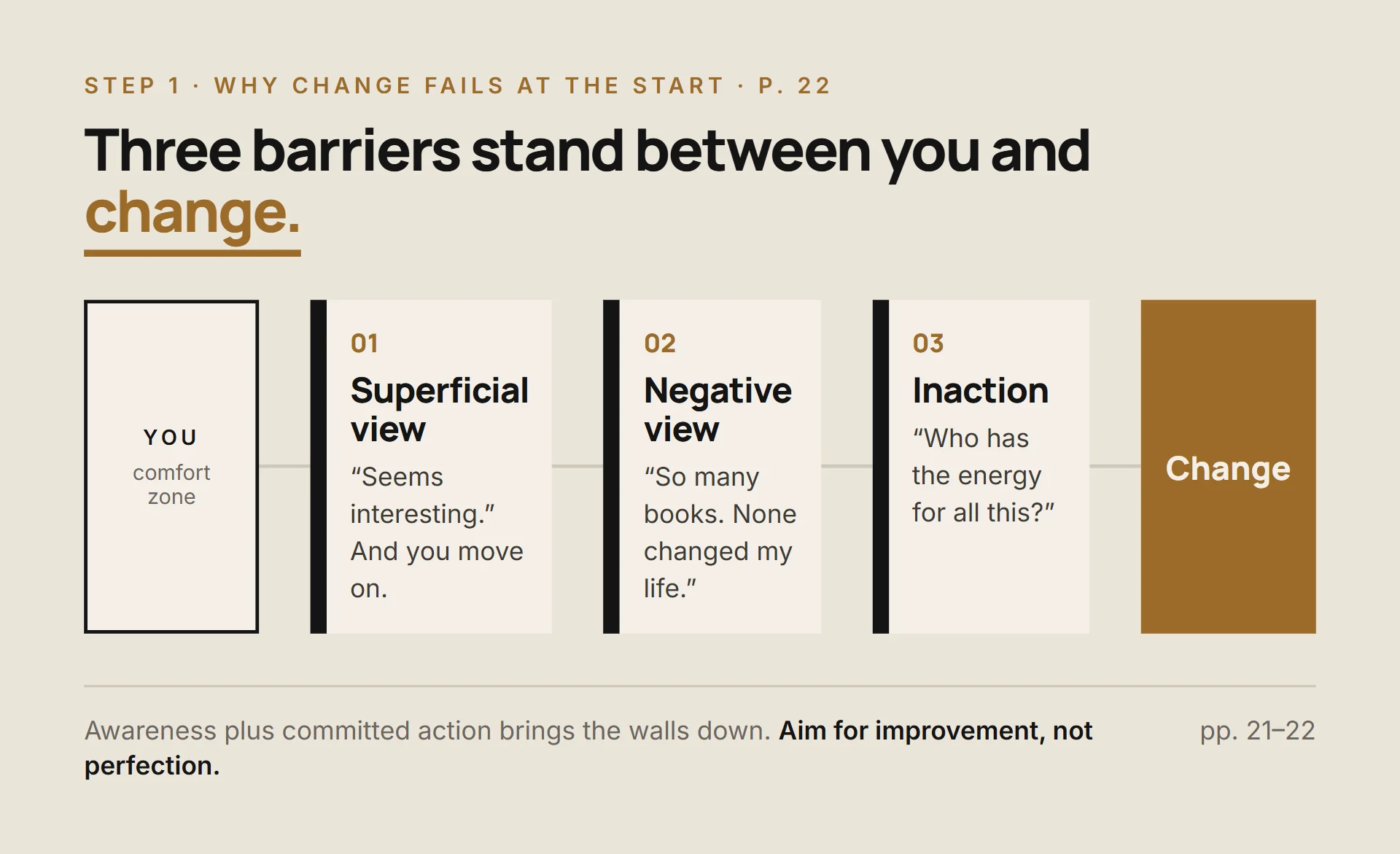
These are old habits of the mind. Once you become aware of them and take committed action, everything can change. Don’t expect sudden change, though. The goal is not perfection. It’s improvement (p. 21).
That’s why I ask for forty days. For the next forty days, give your full attention to this process. These days are pivotal (p. 23).
2. Find out where you are
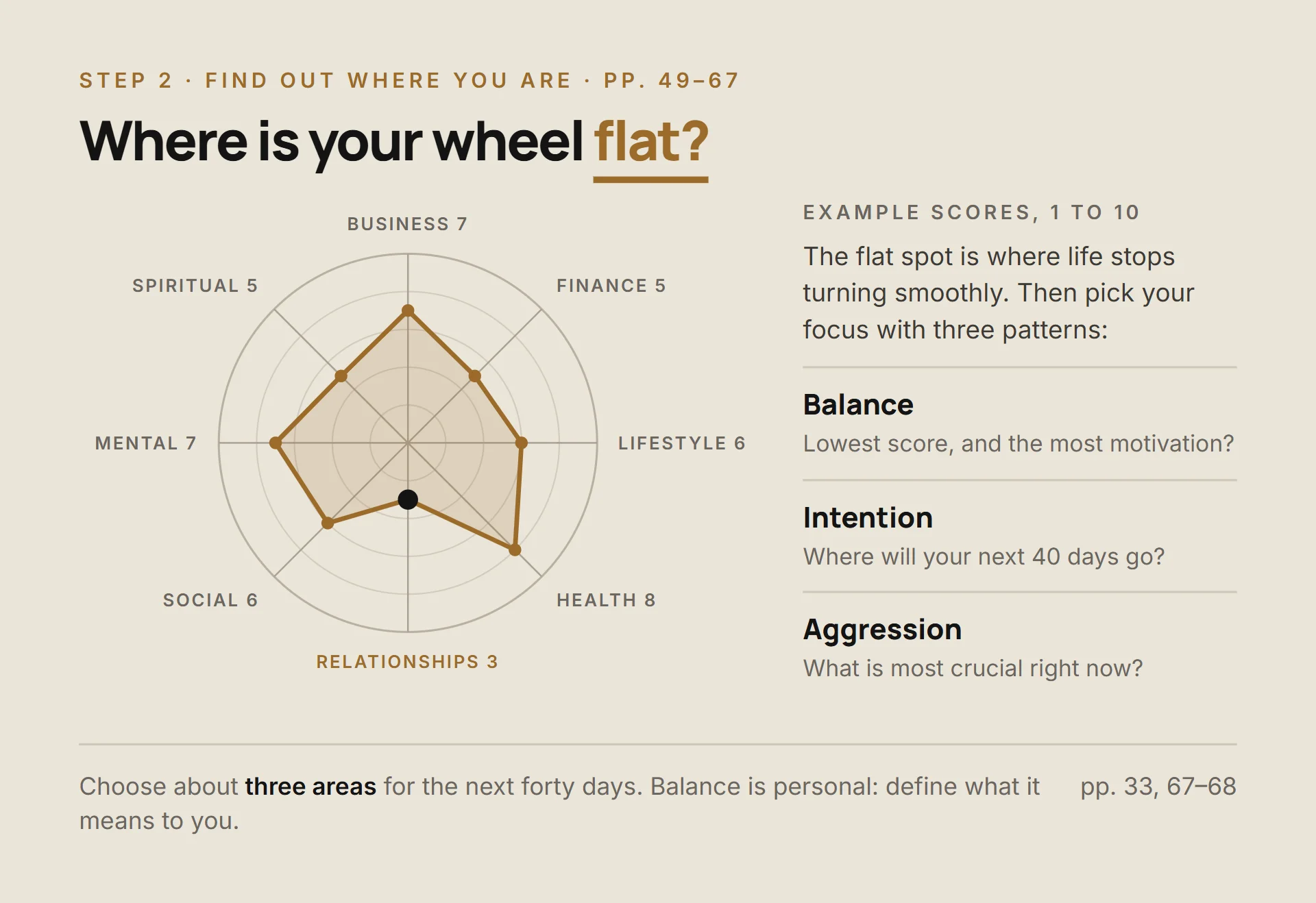
In the book I use the Balance Wheel. It covers eight areas of life: business, finance, lifestyle, health, relationships, social, mental and spiritual. It’s a common method used by business consultants and coaches: assessment through scoring (p. 49).
Score each area from 1 to 10. There are no wrong answers and no negative scores. The only requirement is honesty, and no one else will see your answers. Then connect the points on the wheel. If you see flat spots, you’ll understand why your life may not be turning as smoothly as you’d like.
You can do this right now with the online Balance Wheel, or print the free two-page worksheet.
Then choose where to focus. Three patterns help (p. 67):
- Balance: which area has the lowest score, and do you feel most motivated to improve it?
- Intention: which area do you want to dedicate your time and effort to over the next forty days?
- Aggression: which one is most crucial to improve right now?
From all the areas, choose about three to focus on over the next forty days (p. 68). And remember, balance is personal. It’s not about other people’s standards. It’s about defining what balance means to you (p. 33).
3. Discover what you value
Think of the people you admire. Write down at least five names. The first names that come to mind are often the most significant.
Now choose three. Under each name, list at least ten qualities you admire about them. Mark the traits they share, and write down the three most essential ones. Ask yourself: which qualities set them apart from others, and which ones do I envy them for possessing (p. 41)?
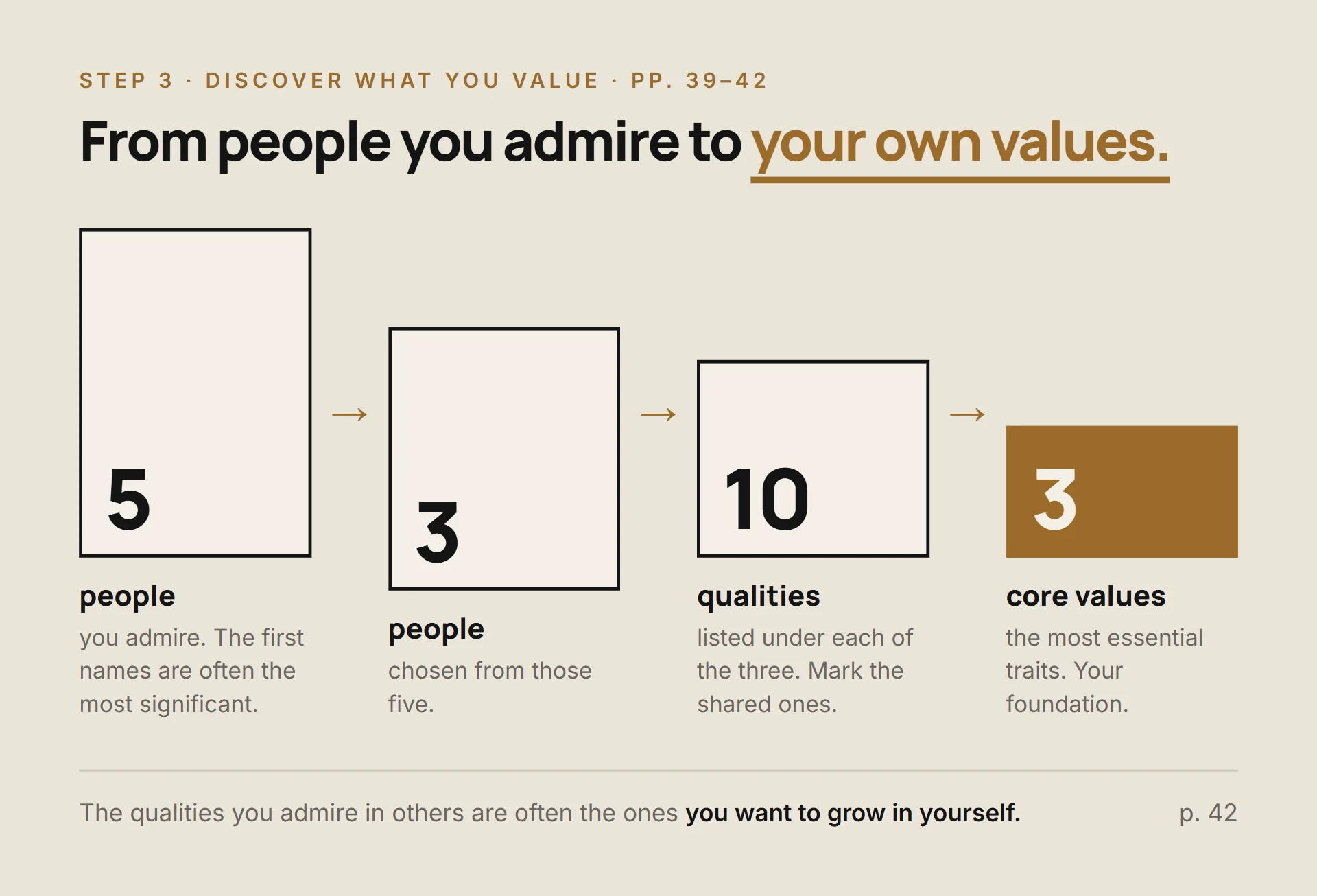
Here’s why this matters. The characteristics you admire in others are often the same traits you wish to cultivate within yourself. These qualities form the foundation of your value system (p. 42). And they directly influence your daily decisions: whether intentionally or not, you tend to choose goals that let you experience these traits in your own life.
4. Decide what you want
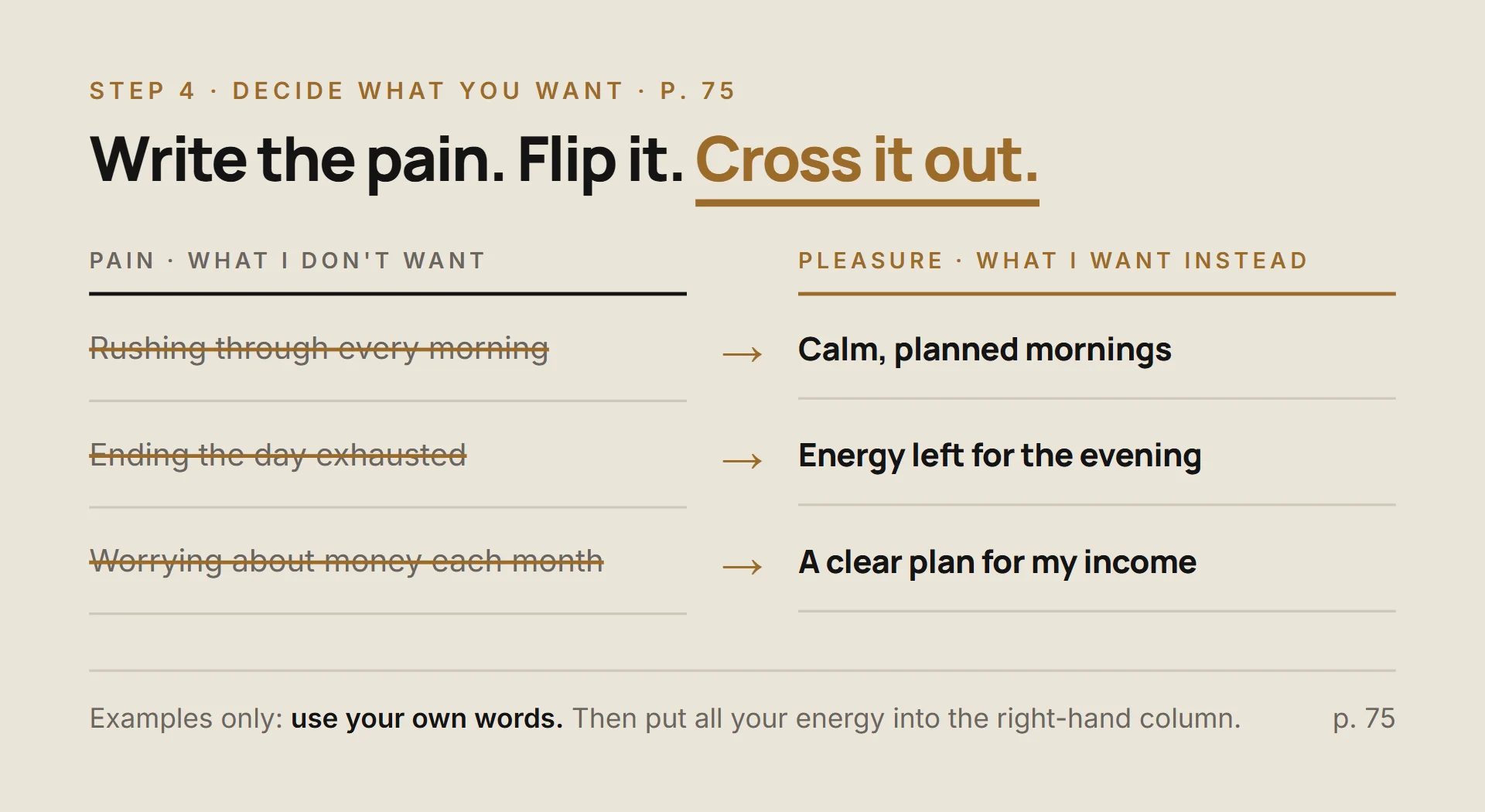
One of the main drivers of our decisions is the desire to avoid pain and seek pleasure. So let’s use it (p. 75).
Draw two columns: pain and pleasure. Under pain, write what you don’t want in your life. What causes you discomfort? What are you trying to distance yourself from? Then, for each one, ask: what would I like to experience instead? Write it under pleasure.
Now cross out the pain. From now on, direct all your attention and energy toward the alternative. The clearer and more specific your goals are, the faster you can achieve them.
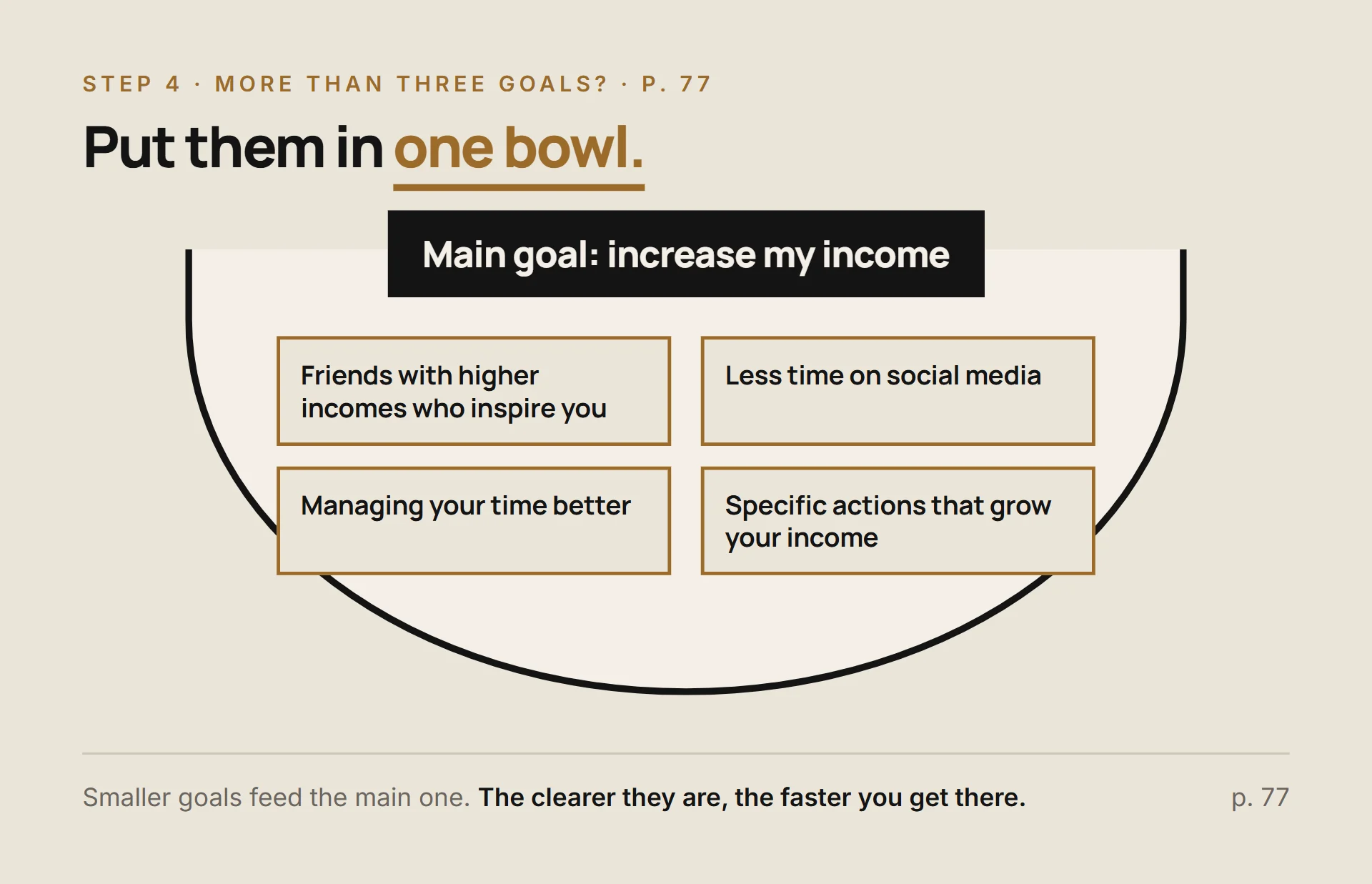
If you have more than three goals, think of them as one bowl (p. 77). Say your main goal is to increase your income. The bowl could hold smaller goals: friends with higher incomes who inspire you, less time on social media, managing your time better, and specific actions that directly grow your income.
5. Turn it into a forty-day goal
Don’t overwhelm yourself. Choose three main goals, and give them forty days or less. When you reach a short-term goal, you build confidence in the process, and that makes your bigger, long-term goals easier and faster. Start with what you can control. Progress there will motivate you to tackle bigger challenges (p. 78).
Next, break each goal into micro-actions. Ask yourself: what do I need to do every day to achieve this goal? An example from the book: the goal is to lose six kilos in forty days, and the micro-action is to walk thirty minutes about five days a week. That’s twenty-five walks.
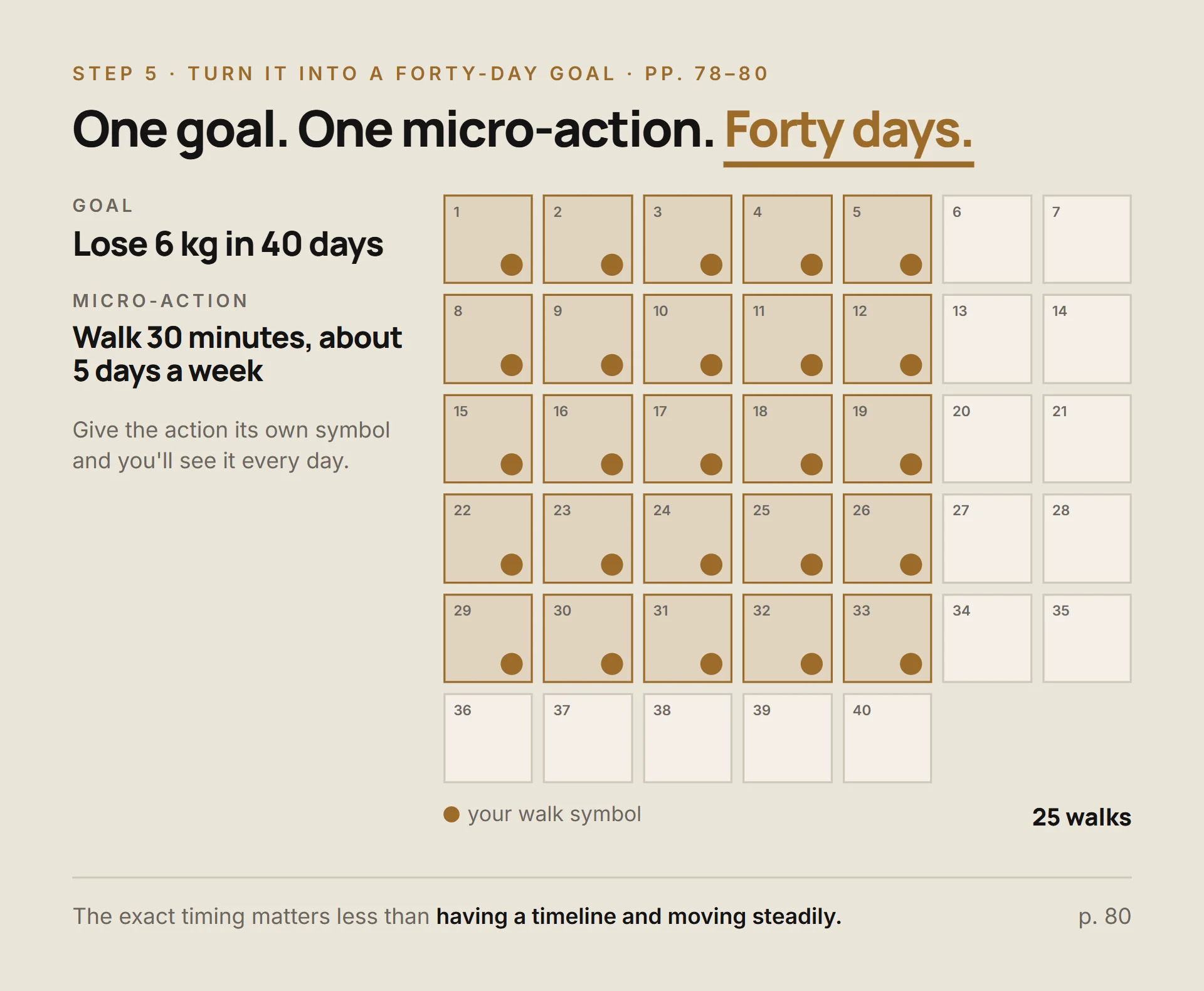
Give each action its own symbol. You’ll see it every day on your daily balance page, and it keeps the action in front of you. The exact timing isn’t what matters most. What matters is that you’ve set a timeline and you’re moving steadily toward it (p. 80).
Be patient. As the saying goes, even if a gardener floods his garden, the trees will not bear fruit out of season. And don’t cling to your goals: don’t sacrifice everything for one goal, like neglecting your body for money, or working so much that you forget your family. A true human being is a balanced human being (p. 81).
6. Every morning: three important tasks
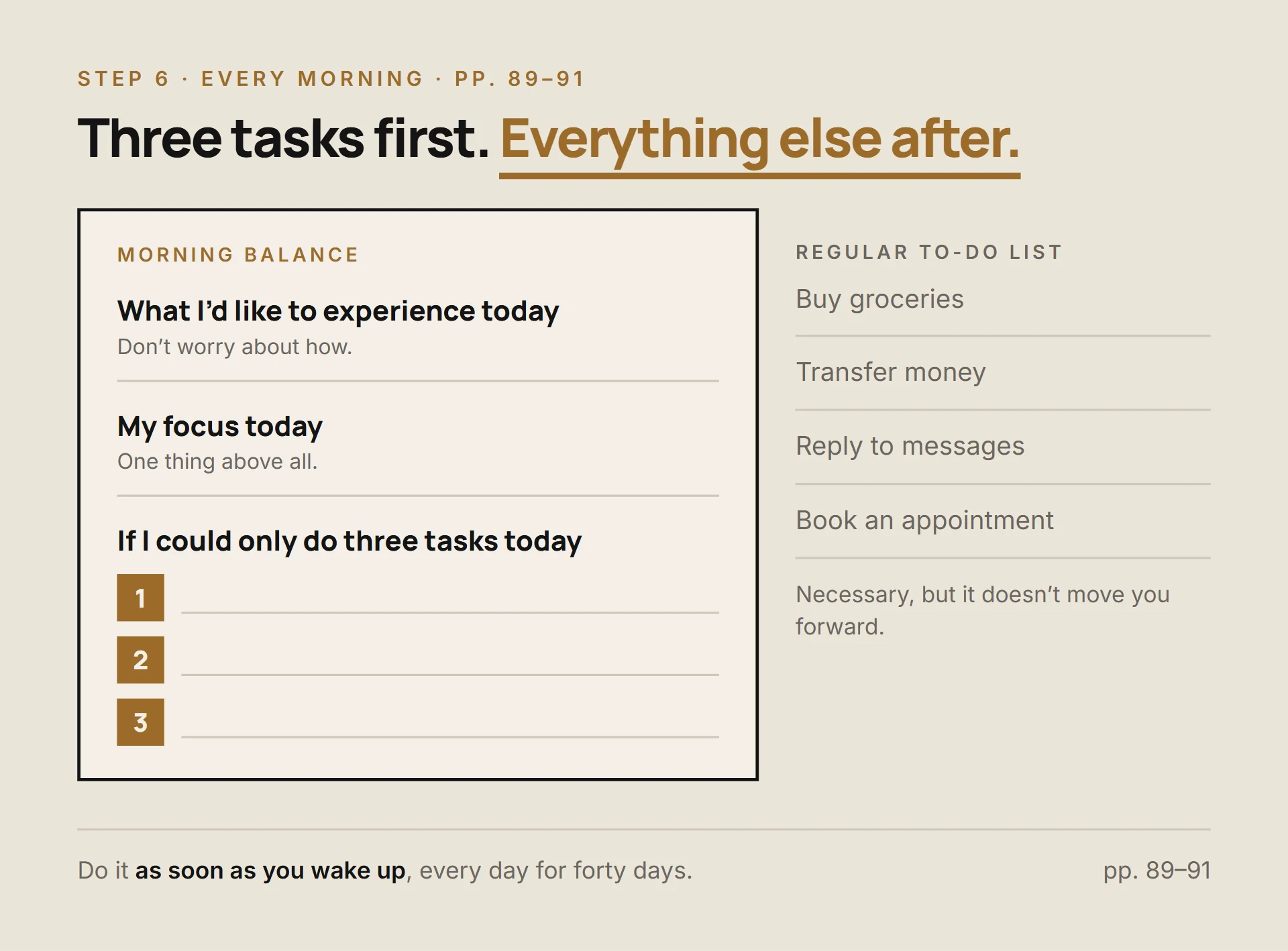
For the next forty days, complete a short morning balance as soon as you wake up (pp. 89–91).
- Write what you’d like to experience today. Don’t worry about how it will happen.
- Choose your focus: what would I like to focus on most today?
- Ask: if I could only complete three tasks today, which three would have the biggest impact? Write those three first.
Everything else, like buying groceries or transferring money, goes on your regular to-do list. Necessary, but it doesn’t directly move you forward.
7. Every night: two questions
Before bed, ask yourself two questions (p. 93):
- What score would I give myself today, from 1 to 10?
- How can I get a better score tomorrow? Find one small step, and decide on it tonight.
Some tasks will stay unfinished. Move the essential ones to tomorrow, and drop anything that’s no longer relevant (p. 94). Then write what you’re thankful for today, something small or significant. It sets the tone for a more energized tomorrow (p. 96).
To score your day, the book uses a simple ten-point template (p. 97):
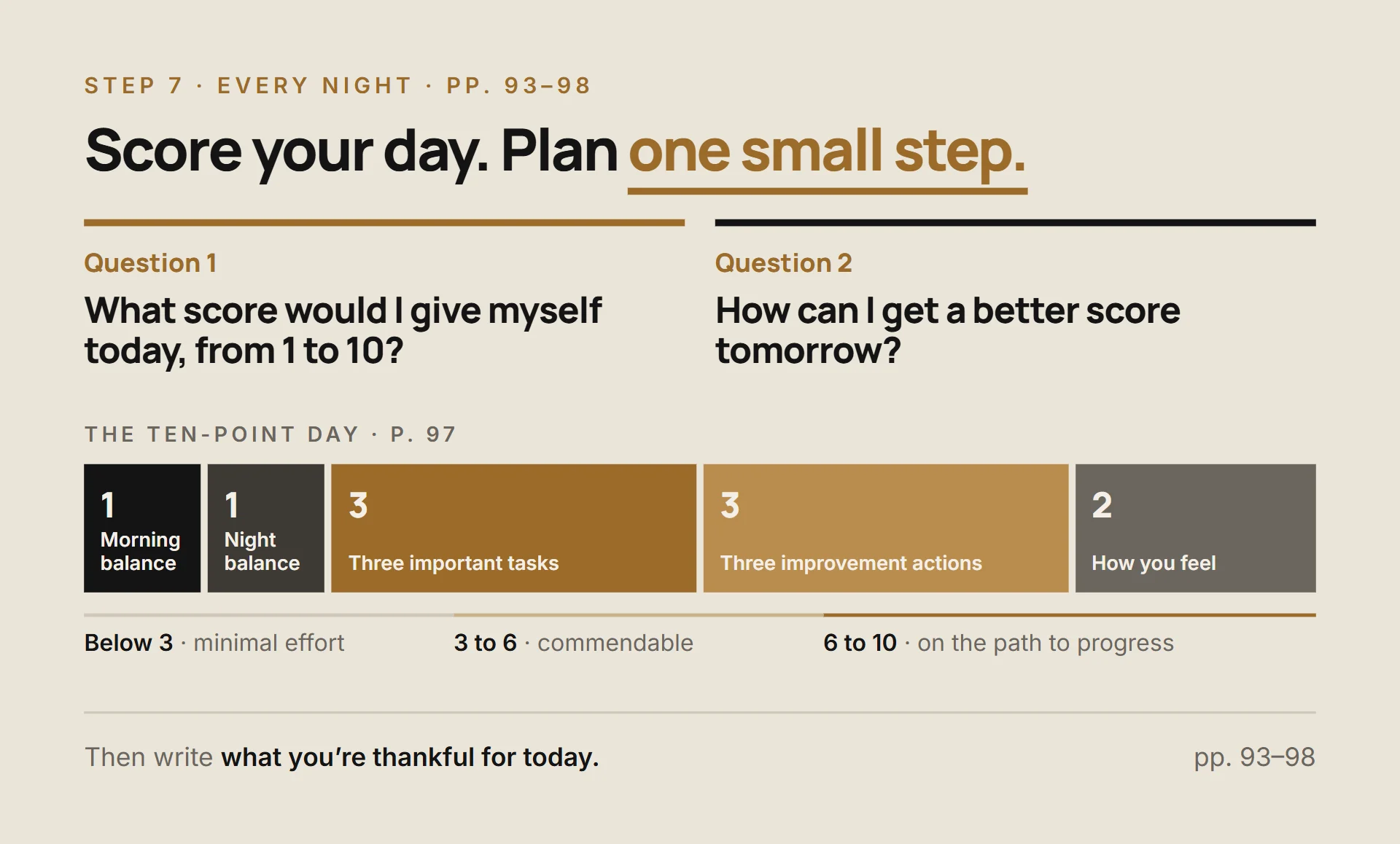
Below 3 means your effort to change has been minimal. From 3 to 6 is commendable. From 6 to 10 means you’re on the path to progress (p. 98). Over time, you’ll live with these questions, moment by moment, wherever you are.
Your forty days
That’s the system. Notice the barriers. Find your balance. Know your values. Decide what you want. Give it forty days. And run it every morning and every night.
Change doesn’t happen in an instant. Find joy in the journey, and let time guide you (p. 96).
Start tonight with step two: rate your life in eight numbers.
The goal is not perfection. It's improvement.
Watch the video

- 40-day goals
- Balance Wheel
- Core values
- Morning and night balance

About the author
Milad Ebrahimi
Productivity coach with 10+ years of coaching, author of Self-Coaching Blueprint and Time Engineering, and founder of ME Academy. Based in Muscat, Oman.
More about Milad →